Time: Beat / Span / Epoch
Gallery Hours: Monday-Thursday: 10am-5pm, Friday: 10am-3pm (Admission is free of charge)
VSU’s Dedo Maranville Fine Arts Gallery and Martha G. Smart Gallery are located on the first floor of the Fine Arts Building, at the intersection of Brookwood Drive and Oak Street.
 |
@VSUMaranvilleGallery |  |
@VSUMaranvilleGallery |
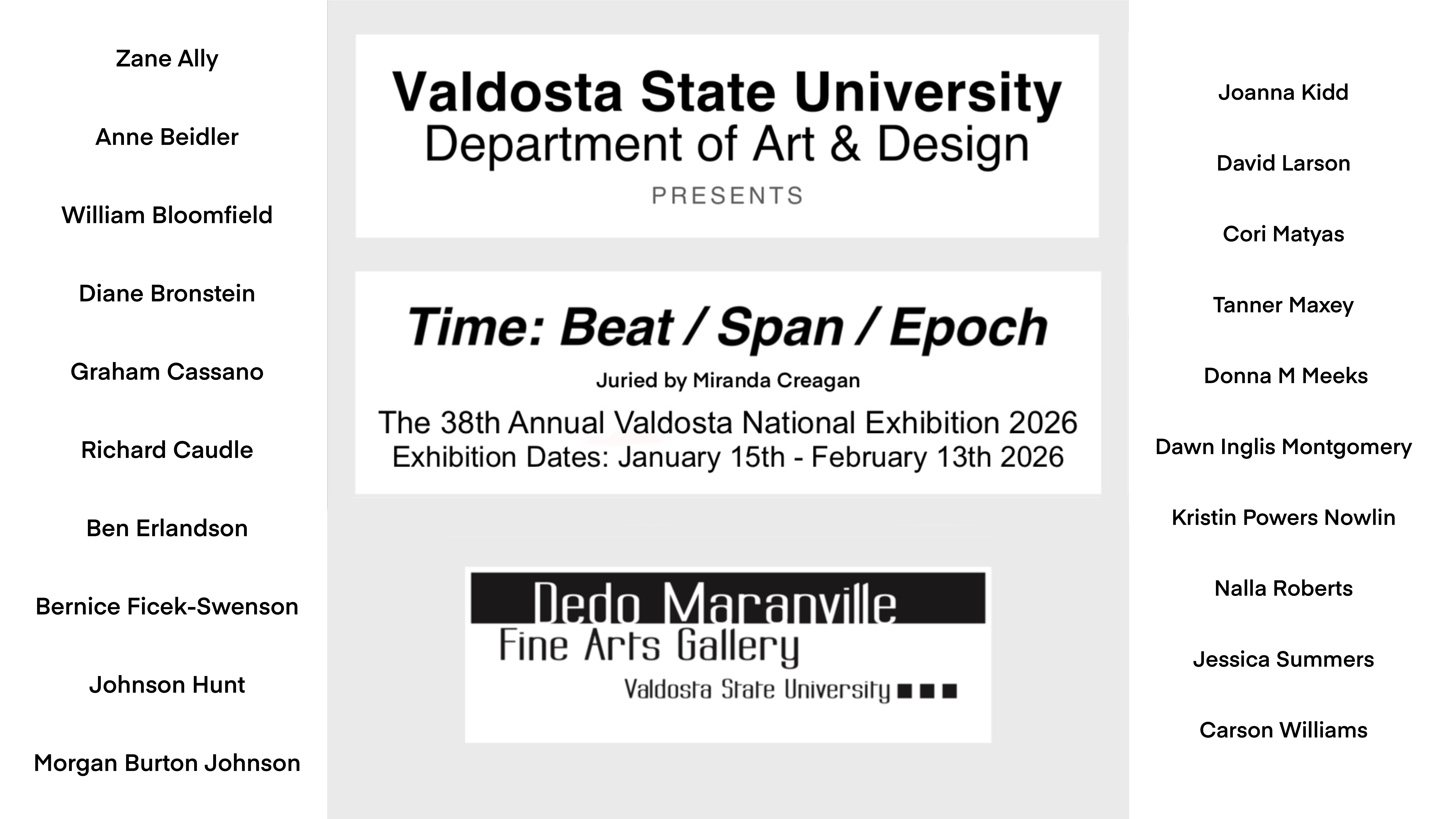
Time: Beat / Span / EpochThe 38th Annual Valdosta National Exhibition 2026 |
|
|
Juror Statement Beat / Span / Epoch presents a rich collection of artistic voices confronting concepts of time, rhythm, and duration. Artists interpreted the exhibition's conceptual framework in many ways. Some explored time as progression in both the beats that mark our days and the spans that define our lives, while others investigated the cyclical nature of epochs, both personal and historical. The works selected for this exhibition were chosen based on artistic merit, diversity of medium, and relevance to theme. Selected pieces demonstrate technical proficiency and conceptual sophistication while pushing their respective mediums in compelling directions. The exhibition reflects a range of artistic practices from traditional to experimental and from intimate to monumental, allowing viewers to experience the breadth of contemporary art. These works don't simply reference time. They invite audiences to experience time: to feel the weight of accumulated moments, to recognize patterns that span generations, and to consider how we mark significance within our own epochs. Together, these pieces represent not just a moment in time but a conversation across it.
Miranda Creagan |
|
ARTISTS
Zane Ally
Statement: Zane Ally is a photographer, filmmaker, and musician that resides in south Georgia working full time as an architectural designer. Zane’s films and photography uses the edges between rural and urban southern life and juxtaposes nostalgia with absurdities of modern life. Primarily utilizing large format, medium format, and 35mm film producing highly detailed images. Zane typically has a documentarian workflow using realism to reflect the abstractions in objects of our of daily life.
Anne Beidler
Statement: Anne Beidler has been a practicing artist, scholar and teacher for more than 35 years. She was on the faculty of Agnes Scott College in Atlanta, 1992-2023, where she was a Professor in the Department of Art and Art History. Her prints, mixed media works on paper and artist books have selected for inclusion in exhibitions and collections throughout the United States and Internationally. Beidler’s mixed-media, layered prints and drawings explore the evolving self, found in the private spaces of thought, body, and memory. She asks how we can maintain connections to our home-place, to our kindred, and to the earth. Her work has often referenced elements of Buddhist poetry, as she continues to discover links between new contemplative spaces and re-considered memories. Her recent works include a series of intimate, hand-pulled prints that examine her interactions with the forest on her daily walks.
William Bloomfield
https://www.williambloomfieldcreative.com/sculpture
Statement: My art background ranges from the performing arts - stage, film, TV acting - to the visual arts, as a stone sculpture, and more recently (as my ability to carry heavy rocks wanes), photography. I've been taking pictures since I was a teen and was in a few shows then and always carried a camera. I'm particularly drawn to people engaged in daily life, the bustle of communities, and unusual landscapes. Then there are animals... Currently I've been using an iPhone, instead of a 35mm, as it's more convenient and less obvious while photographing live subjects. That said, I'll go back to more advanced cameras in the near future.
Diane Bronstein
https://speedygale.wixsite.com/unreal-city/cv
Statement: My work is based on the fiction of Shirley Jackson. As a pre-eminent horror writer of the 20th century, Jackson based her novels and stories on the unease of modern life, particularly for women. These pieces consist of found vintage black and white photos that I heavily embroidered. Using anonymous photos and pages from an heirloom 1886 dictionary, I create collages of each story with clues pertinent to the plot. The Haunting of Hill House examines generational conflicts in both the actual house and in relationships of the characters attempting to identify the entities that refuse to leave. Eleanor, the protagonist, has devoted most of her life to caring for her ailing mother. The house itself seems determined to have her continue this role into perpetuity. Hangsaman, is told out of sequence.Natalie, a freshman at a women’s college in the 1950s, grapples with the psychological after effects of a probable assault. We learn her story through her confusion of time and reality.
Graham Cassano
https://cassanophotography.com
Statement: "November" was conceived in the late summer, and executed that summer and fall, leading up to its completion, mid-November, 2024. That point in time matters, for reasons that extend beyond the frame containing this fissure. Still, the gap captures its force. Processes used to create the image participate in its meaning, through space and over time. Sections of the fence affixed to silver remain relatively vivid, while iron tiles rust to indeterminacy. The final layer of cyanotype images were toned using a strong tannic acid solution. In sunlight, those tiles fade more rapidly, slowly destroying the façade until the structure loses its form. This may take a year, or, in darkness, a decade. But all fences fall.
Richard Caudle
Statement: My digital creations of late begin with photography, but as Robert D. Jones said, “I make the image, not the camera” . Philosophically, I would classify myself as an existentialist in that I see the creative process as the purpose and the resulting “work of art” as basically an additional benefit to both myself and the viewer. I do not intend for my representational images to be message pieces, but would hope that through the design and imagery, both I and the viewer will be transported to a path of self discovery. Of late, I have been exploring themes of time, memory and history. My fascination with what makes us who we are and where we came from guide my latest art offerings. Richard L. Caudle
Ben Erlandson
https://www.erlandsonphotography.com/
Statement: Benjamin Erlandson combines natural light photography and timelapse to interpret natural and built landscapes across scales. Separately and together, these forms help us explore a sense of place for each of us within these spaces, within a single moment or across different time scales. The purpose of the compositions is to encourage us all to think beyond ourselves, our immediate surroundings, and shallow time horizons, expanding into something deeper and broader than what is an increasingly distracted frenetic existence (collectively and individually) on this planet we share with all species. By using various media modalities to explore the juxtaposition of space, time, and light from both internal and external perspectives of human (and non-human) relationships with water and watersheds, Erlandson can create the opportunity for awareness, understanding, and appreciation of the complexities of the world in which we live, starting with a sense of place.
Bernice Ficek-Swenson
https://berniceficek-swenson.com
Statement: Drafting geological maps early in my career introduced me to many rock specimens, culminating in the opportunity to hold a moon rock in my hand, a moment enlarging my perception of deep geologic time. My imagery has expanded from using stone to suggest landscape and geologic time to a concern about environments touched by human presence and the stories shared about each site. Land retains memories, history. Exploring a landscape, I consider the unspoken narrative underfoot. The ground represents and reveals time discretely: the infinitely slow transformation, an instantaneous, catastrophic event and the enduring memory of human impact, all influencing the land. A small stone specimen borrowed from a location needs to imply the surrounding terrain or hint at the history of the site, a passage of time. Fragmentary contemplations used from my fieldnotes are incorporated into my stone portraits. This interplay between the physical strata and the geographies of the mind I find compelling.
Department of Art & Design
-
VSU - College of the Arts
Department of Art & Design
Fine Arts Building
Room 1070A - 1st Floor
204 West Brookwood Drive
Valdosta, GA 31601 -
Mailing Address
1500 N. Patterson St.
Valdosta, GA 31698 - Phone: 229.333.5835
- Monday-Thursday
8:00 a.m. - 5:30 p.m.
Friday
8:00 a.m. - 5:00 p.m.