Hazing Transparency and Max Gruver Report
Valdosta State University prohibits hazing. Hazing means any intentional, knowing, or reckless act committed against another person, regardless of that person’s willingness to participate, that is connected to initiation into, affiliation with, or membership in a student organization or group and that causes or creates a risk of physical or psychological injury above the reasonable risks of ordinary organizational activities. A person’s consent or willingness to participate is not a defense. This prohibition applies to all students, faculty, staff, and affiliated organizations and extends to conduct occurring both on campus and at university-sponsored or university-affiliated activities off campus.
In accordance with the federal Stop Campus Hazing Act and Georgia’s Max Gruver Act, the University publicly reports hazing violations and institutional responses to promote transparency, accountability, education, and prevention.
What is Hazing?
"Hazing is a criminal offense under Georgia law (O.C.G.A. § 16-5-61, the Max Gruver Act). It is unlawful for any person to haze a student in connection with gaining or maintaining membership or status in a school organization. Hazing includes activities that endanger physical health or coerce consumption of substances that risk intoxication or unconsciousness, regardless of the student's willingness to participate. A violation is a misdemeanor of a high and aggravated nature and may result in criminal penalties in addition to university discipline."
Campus Hazing Transparency and Max Gruver Report
Immediate Reporting and Assistance
If there is an immediate threat to health or safety, call 911 or contact University Police immediately.
For non-emergency hazing reports, concerns, or requests for assistance, please use the reporting and support resources listed below.
| Report a Hazing Incident |
- Office of Student Conduct & Title IX Office
- Dean of Students Office
- USG Ethics Hotline – 1-866-495-7754 (Confidential)
- Campus Safety and Security: (24/7)
- Emergency Line 229.259.5555
- Non-Emergency 229.333.7816
- Local Emergency Services: 911
- Crisis Support: National Crisis Text Line – Text HOME to 741741 Free 24/7
- Counseling Services: 24/7 Support Line 833-910-3365
- Counseling Center : (229) 333-5940 8:00am-5:00pm Monday-Friday.
Each USG institution is required by law to publish the Hazing Transparency and Max Gruver report. This report provides information about student organizations that have been found responsible for hazing through the University's student conduct process or have been subject to a criminal conviction related to hazing. Information will be added to the report within 15 days of a Student Conduct Hearing if a student/organization is found Responsible for hazing or within 15 days of a criminal conviction for hazing.
Even when there are no cases/findings of responsibility, the report will be updated no less than every six months, noting that the university had no findings of Responsible or no hazing reports during that period.
In cases where students/organizations were found responsible for hazing, the information that will be included in the report will reflect:
- Organization Name – The student organization found responsible for the violation.
- Incident Date(s) – The date or dates on which the hazing conduct occurred, when known.
- Investigation Timeline – Key dates, including the initiation of the investigation, conclusion of the investigation, and notification of the organization's final outcome.
- Violation Summary – A general description of the hazing conduct, including whether alcohol or drug misuse was involved.
- Findings and Sanctions – The University's determination, disciplinary sanctions imposed, and any related criminal convictions, if applicable.
- Policy Violations – The specific provisions of the Student Code of Conduct that were violated.
Hazing allegations involving students or student organizations are initially investigated by University Police to determine if criminal charges must be brought. The case is then referred to the Office of Student Conduct & Title IX who will oversee the investigation as outlined in the Student Code of Conduct (I would link to the code).
During their initial review immediately after a report is received, UPD may work with the Office of Student Conduct & Title IX to determine if any temporary or interim measures need to be imposed.
UPD will follow all laws as required when undergoing their investigation. The Office of Student Conduct & Title IX will take the following steps:
- Send the accused student or organization notice of the report, allowing them an opportunity to respond in writing.
- If possible, an informal resolution may be reached if the student/organization takes responsibility for the allegations and accepts the sanctions assigned. If there is significant or irreparable harm, no informal option will be available.
- Cases that need to be heard by a hearing panel are assigned to trained investigators who gather information through interviews and other evidence, documenting their findings and timeline that will be shared with involved parties and the hearing panel.
- Using a Preponderance of the Evidence standard, the hearing panel will determine if policy was violated. A written decision will be provided within 72 hours. In cases where sanctions are assigned, individuals have the right to appeal to the Dean of Students within five days of the written decision.
- Possible sanctions include extended cease and desist orders, privilege restrictions, removal as a registered organization, restitution, community services; both mitigating and aggravating factors would be considered when assigning sanctions.
Individuals must cooperate with the investigation, and retaliation is prohibited.
Hazing violations involving school or student organizations are published in VSU’s Campus Hazing Transparency and Max Gruver Report, available at https://cm.maxient.com/chtr.php?ValdostaStateUniv.
There are protections provided to those reporting hazing and those involved in the process.
Privacy will be protected to the extent possible. To ensure compliance with applicable laws, information listed in the report excludes:
- Personally identifiable information about students or other individuals involved.
- Allegations that did not result in the finding of responsibility.
- Cases that remain under active investigation or have not reached a final resolution.
- Information protected by the Family Educational Rights and Privacy Act (FERPA) or other applicable privacy laws.
Individuals are protected against retaliation. The University prohibits retaliation against any individual who reports hazing, participates in an investigation, serves as a witness, or otherwise engages in a good-faith effort to address potential violations. Allegations of retaliation may result in separate disciplinary action.
What Is Retaliation?
Retaliation is any adverse action taken against an individual because of their involvement in reporting, investigating, or addressing hazing. Examples include, but are not limited to:
-
- Harassment or intimidation
- Threats or coercion
- Exclusion from organizational activities or membership opportunities
- Academic or employment-related penalties
- Disciplinary action taken in response to protected participation.
Reporting Retaliation
Suspected retaliation should be reported promptly through the University's hazing reporting channels or other designated reporting mechanisms. All reports of retaliation will be reviewed and investigated in accordance with university policies and procedures.
Disciplinary Action
Individuals or organizations found responsible for retaliation may be subject to disciplinary action, up to and including suspension, loss of organizational recognition, dismissal, or other sanctions deemed appropriate by the University.
Reported Hazing Violations
In accordance with the Family Educational Rights and Privacy Act of 1974 the report shall not include or otherwise reveal any personally identifiable information. Hazing related violations will be maintained for five (5) years. This report will be updated no less than two times each year and within 15 days of any final adjudication of hazing violations.
Campus Hazing Transparency and Max Gruver Report
Annual Security and Fire Safety Report
Beginning October 1, 2026, hazing statistics and information regarding the University's hazing prevention and awareness programs will be included in the Annual Security and Fire Safety Report. 2025 Annual Security & Fire Safety Report
Hazing prevention education, Bystander intervention training, Leadership development, Student organization education, Faculty/staff awareness initiatives.
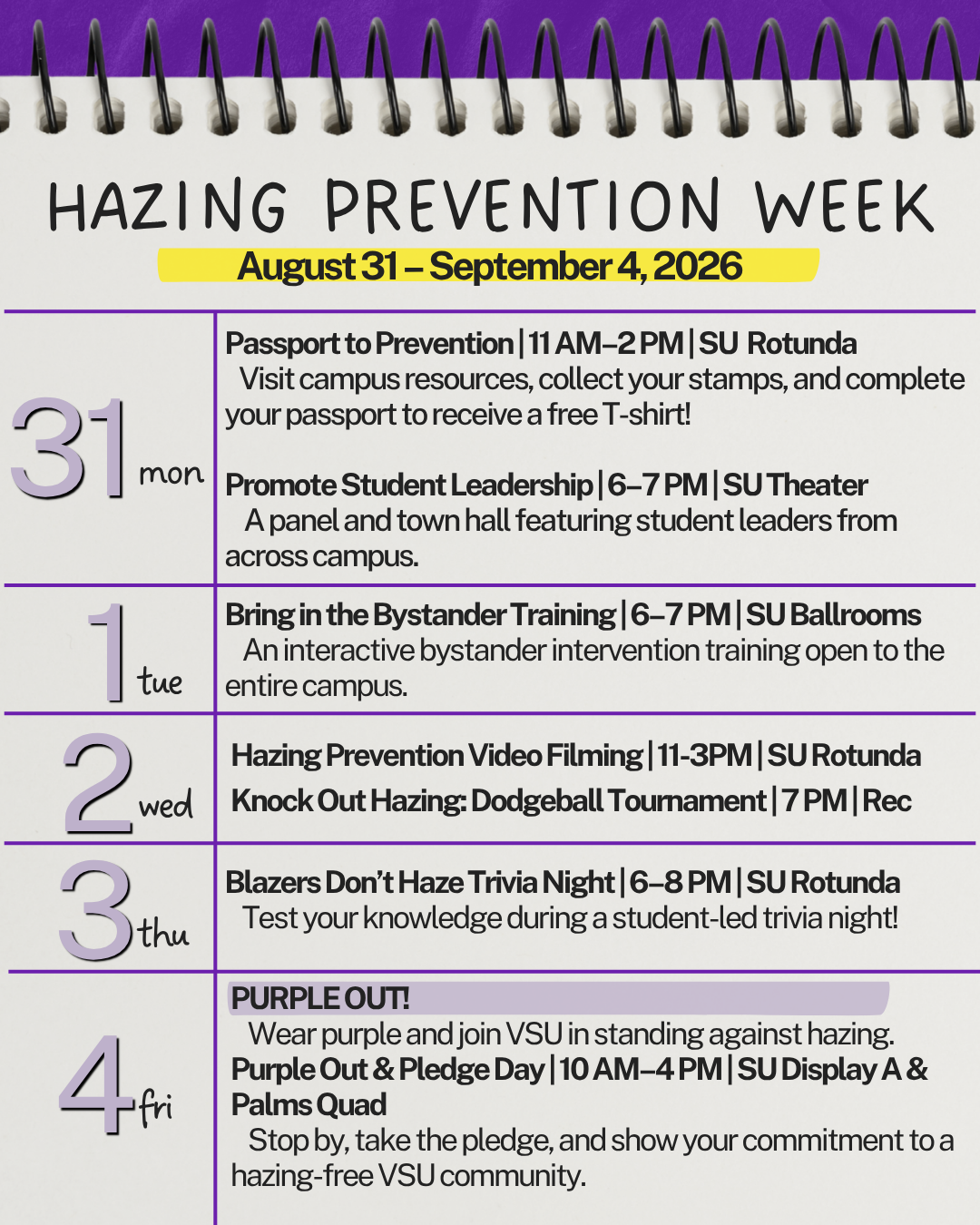
This month is Hazing Prevention month. This week we hosted several events for students and the VSU community. The flyer of said events is included. SCAC provides pop-up events on hazing around campus. SCOTIX utilizes its social media presence to post information about hazing. SCOTIX is working to get the list to submit to VECTOR so all students can complete the hazing training they provide. All new students will complete it thereafter, and refreshers will be completed as necessary.
Greek organizations are required to read the hazing information in the Greek Life Student Handbook and sign the agreement that they have read, understand, and will not engage in hazing.
Immediate Reporting and Assistance
If there is an immediate threat to health or safety, call 911 or contact University Police immediately.
For non-emergency hazing reports, concerns, or requests for assistance, please use the reporting and support resources listed below.
| Report a Hazing Incident |
- Office of Student Conduct & Title IX Office
- Dean of Students Office
- USG Ethics Hotline – 1-866-495-7754 (Confidential)
- Campus Safety and Security: (24/7)
- Emergency Line 229.259.5555
- Non-Emergency 229.333.7816
- Local Emergency Services: 911
- Crisis Support: National Crisis Text Line – Text HOME to 741741 Free 24/7
- Counseling Services: 24/7 Support Line 833-910-3365
- Counseling Center : (229) 333-5940 8:00am-5:00pm Monday-Friday.
Each USG institution is required by law to publish the Hazing Transparency and Max Gruver report. This report provides information about student organizations that have been found responsible for hazing through the University's student conduct process or have been subject to a criminal conviction related to hazing. Information will be added to the report within 15 days of a Student Conduct Hearing if a student/organization is found Responsible for hazing or within 15 days of a criminal conviction for hazing.
Even when there are no cases/findings of responsibility, the report will be updated no less than every six months, noting that the university had no findings of Responsible or no hazing reports during that period.
In cases where students/organizations were found responsible for hazing, the information that will be included in the report will reflect:
- Organization Name – The student organization found responsible for the violation.
- Incident Date(s) – The date or dates on which the hazing conduct occurred, when known.
- Investigation Timeline – Key dates, including the initiation of the investigation, conclusion of the investigation, and notification of the organization's final outcome.
- Violation Summary – A general description of the hazing conduct, including whether alcohol or drug misuse was involved.
- Findings and Sanctions – The University's determination, disciplinary sanctions imposed, and any related criminal convictions, if applicable.
- Policy Violations – The specific provisions of the Student Code of Conduct that were violated.
Hazing allegations involving students or student organizations are initially investigated by University Police to determine if criminal charges must be brought. The case is then referred to the Office of Student Conduct & Title IX who will oversee the investigation as outlined in the Student Code of Conduct (I would link to the code).
During their initial review immediately after a report is received, UPD may work with the Office of Student Conduct & Title IX to determine if any temporary or interim measures need to be imposed.
UPD will follow all laws as required when undergoing their investigation. The Office of Student Conduct & Title IX will take the following steps:
- Send the accused student or organization notice of the report, allowing them an opportunity to respond in writing.
- If possible, an informal resolution may be reached if the student/organization takes responsibility for the allegations and accepts the sanctions assigned. If there is significant or irreparable harm, no informal option will be available.
- Cases that need to be heard by a hearing panel are assigned to trained investigators who gather information through interviews and other evidence, documenting their findings and timeline that will be shared with involved parties and the hearing panel.
- Using a Preponderance of the Evidence standard, the hearing panel will determine if policy was violated. A written decision will be provided within 72 hours. In cases where sanctions are assigned, individuals have the right to appeal to the Dean of Students within five days of the written decision.
- Possible sanctions include extended cease and desist orders, privilege restrictions, removal as a registered organization, restitution, community services; both mitigating and aggravating factors would be considered when assigning sanctions.
Individuals must cooperate with the investigation, and retaliation is prohibited.
Hazing violations involving school or student organizations are published in VSU’s Campus Hazing Transparency and Max Gruver Report, available at https://cm.maxient.com/chtr.php?ValdostaStateUniv.
There are protections provided to those reporting hazing and those involved in the process.
Privacy will be protected to the extent possible. To ensure compliance with applicable laws, information listed in the report excludes:
- Personally identifiable information about students or other individuals involved.
- Allegations that did not result in the finding of responsibility.
- Cases that remain under active investigation or have not reached a final resolution.
- Information protected by the Family Educational Rights and Privacy Act (FERPA) or other applicable privacy laws.
Individuals are protected against retaliation. The University prohibits retaliation against any individual who reports hazing, participates in an investigation, serves as a witness, or otherwise engages in a good-faith effort to address potential violations. Allegations of retaliation may result in separate disciplinary action.
What Is Retaliation?
Retaliation is any adverse action taken against an individual because of their involvement in reporting, investigating, or addressing hazing. Examples include, but are not limited to:
-
- Harassment or intimidation
- Threats or coercion
- Exclusion from organizational activities or membership opportunities
- Academic or employment-related penalties
- Disciplinary action taken in response to protected participation.
Reporting Retaliation
Suspected retaliation should be reported promptly through the University's hazing reporting channels or other designated reporting mechanisms. All reports of retaliation will be reviewed and investigated in accordance with university policies and procedures.
Disciplinary Action
Individuals or organizations found responsible for retaliation may be subject to disciplinary action, up to and including suspension, loss of organizational recognition, dismissal, or other sanctions deemed appropriate by the University.
Reported Hazing Violations
In accordance with the Family Educational Rights and Privacy Act of 1974 the report shall not include or otherwise reveal any personally identifiable information. Hazing related violations will be maintained for five (5) years. This report will be updated no less than two times each year and within 15 days of any final adjudication of hazing violations.
Campus Hazing Transparency and Max Gruver Report
Annual Security and Fire Safety Report
Beginning October 1, 2026, hazing statistics and information regarding the University's hazing prevention and awareness programs will be included in the Annual Security and Fire Safety Report. 2025 Annual Security & Fire Safety Report
Hazing prevention education, Bystander intervention training, Leadership development, Student organization education, Faculty/staff awareness initiatives.
This month is Hazing Prevention month. This week we hosted several events for students and the VSU community. The flyer of said events is included. SCAC provides pop-up events on hazing around campus. SCOTIX utilizes its social media presence to post information about hazing. SCOTIX is working to get the list to submit to VECTOR so all students can complete the hazing training they provide. All new students will complete it thereafter, and refreshers will be completed as necessary.
Greek organizations are required to read the hazing information in the Greek Life Student Handbook and sign the agreement that they have read, understand, and will not engage in hazing.
University Police
-
Oak Street Parking Deck
1410 North Oak St.
Valdosta, GA 31698 -
Mailing Address
1500 N. Patterson St.
Valdosta, GA 31698 - Emergency Line
- Phone: 229.259.5555
- Non-Emergency
- Phone: 229.333.7816
- Anonymous Tip Line
- Phone: 229.219.3171
- Fax
- Phone: 229.249.4863